Showing posts with label Ustad Fateh Ali Khan. Show all posts

Saturday, December 28, 2013

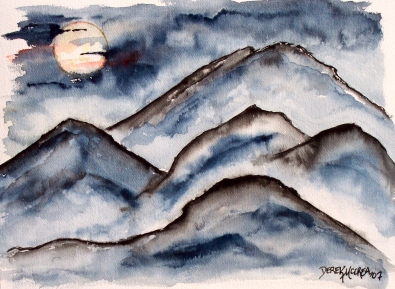
Pahadi… the Mountains’ Call


 “Peace, power, pathos, poignancy: these words together constitute an apposite expression of the aesthetics of the raga Pahadi. The raga is like a lover, unruffled in union, serene in separation, powerful enough to achieve eternal union, but resigned to the painful parting ordained by destiny”.
~Haresh Bakshi, 101 Ragas for the 21st century and beyond


The mountains are a synonym of home for me for I grew up in their midst. The scent of the pines to breathe in, the silhouettes of the peaks on the horizon, just after the sunset, to watch...the fresh, crisp morning air to feel, and the lovely folk music to listen.... I miss all these when I am away from home. No wonder then that almost every time I hear a song that takes me back to the hills, it turns out that it is set in the raga Pahadi- A raga that is said to have been evolved from the folk melody of this region that spans from Nepal, to Kashmir, to Himachal and more..


This unplugged version of Kaaga Ja, a composition based on Pahadi, sung by Shafqat takes my breath away each time I hear it. It was a part of the album called Kyun Dooriyan.


A “light” Raga?

The raga is often found appropriate for and used in semi classical and light music forms like thumri, dadra, ghazals and bhajans. Ustad Salamat Ali Khan in this interview talks of Pahadi and almost writes it off as a raga. He says that he hardly considers it a raga- it is more like a halka phulka raga at the most since unlike the other big ragas like Darbari and Malkauns artists don’t really sing Dhrupad and Khayal in Pahadi.  He also adds that Pahadi and Bhairavi are the very common templates into which most of the world music would fit in
But ironically, it is he, who has sung some of the most beautiful pieces of Pahadi

He demonstrates the universality of Pahadi by singing it in various styles here


And here is are two very famous Pahadi thumris by him and his brother Nazakat Ali

Laagi re manwa pe chot..


Saiyan bina ghar soona..,


Pahadi and the Patiala Gharana

Talking of Pahadi, one of the contemporaries of Ustad Salamat Ali Khan and the Patiala Gharana legend, Ustad Bade Ghulam Ali Khan has also rendered some very beautiful pahadi pieces.

First and foremost his bhajan- Hari Om Tatsat. Words, which when  translated, mean -God is the supreme, absolute truth


Ab to aao sajana… Pahadi dadra


And this endearing Kashmiri/ pahadi folk song- Mhare Raje de jamadar jee…


Another beautiful rendition of the same song by Bashir Ali Mahee of the Patiala Gharana can be heard here 

The raga belongs to the Bilawal that under the Bhatkande system of classification and is Audav-Sampoorna Raga, with swaras Ma and Ni not being used in the Aaroh, while all seven swaras being used in the Avroh or the descent.

Aroha: S R G P D S'
Avaroha: S' D P G R S.


Meant to be sung in the evening and early night hours, Pahadi is usually rendered in the mandra and madhya saptak- the lower and middle octaves. However the restrictions on timing of rendition are no longer strictly followed and it is one of the ragas that can be performed at any time of day/ night

Coming back to Pahadi by the Patiala Gharana, here is the living legend from the gharana, Ustad  Fateh Ali Khan rendering a beauty- More Angna suhag barasan laaga


And then this beautiful Punjabi song in Pahadi- Kidda Sona lagna hai mere dholna, rajj rajj tere naal bolna                                                                                                                               


Pahadi Instrumental & the Folk Connection

Talking of Pahadi in instrumental music the two instruments that transport you instantly to the hills are the Flute and Santoor.

The sounds of flute meander through the ranges, echoing the free spirit that they represent and then raise your spirit to peaks of ecstasy…just like the mountains soar up to the skies.

And what embellishes and further adorns the breathtaking beauty of the hills is the water- free-falling waterfalls along the rocky facades of mountains, or the bubbly, playful, streams bounding along the uneven bouldered paths, or a large placid lake guarded protectively by hills with a gently rippling reflection of the moon on a cold silent night…the sound of the water is the sound of santoor for me.

And when you talk of these two instruments then you can’t but talk about their greatest exponents- Pandits Hariprasad Chaurasia and Shiv Kumar Sharma. Their collaboration on the album -Call of the Valley produced this beautiful and commonly heard Pahadi tune


And the flavor of this tune also can be experienced in a well -known Himachali folk song called Kunjo- Chanchalo. Here’s an instrumental version of the same.


And here’s Ustad Shujat Hussain Khan combining the magic of his sitar with another folk beauty- Lajo, Lajo


Traces of the same can be experienced in this Himachali folk song from Kangra..


Pahadi in Hindi Films

Pahadi based film songs would make a whole new series of blog post because of the sheer number of the songs based on /inspired by this by this beautiful raga
But here I mention a few of my favorites-
This much loved, Naushad composition from the 1945 Anmol ghadi sung superbly by Noorjehan


Lata Manageshkar in this gem from the Film Bazaar ( 1949) with music by ShyamSundar


Music of Pakezaah is a music lover’s delight and the background score by Nasuhad included some divine thumris by artists of great stature Like Shobha Gurtu and Parveen Sultana. A delightful thumri in pahari by Vani Jayram- Mora Saajan Soutan is also a part of these “ Lost thumris of Pakeezah” and you can read about it the listen to it here


Music director Jaidev and lyricist Jaan Nisar Akhtar together captured the essence of Pahadi truly with this absolutely amazing number

Dhadakte hain dil kitni aazadiyon sey, bahut milte julte hain in waadiyon sey


Pahadi goes South

I was surprised to see the pahadi presence in Carnatic music as well…  this  is a Pahadi thillana composed and performed by Lalgudi for his album South meets North with Amjad Ali Khan


And this is a version of the same by the Hyderabad Brothers for their album called Annapoorne


Ghazals in Pahadi

And finally some beautiful use of Pahadi for ghazals- there’s Ghulam Ali’s - dil mein ik lehersi uthi hai,  but this one by Mehdi Hassan with the  mesmerizing words by Bahadur Shah Zafar  has always been an absolute favorite.


Ending where we started- with the album version of Shafqat’s Kaaga Ja as this one song demonstrates  how  Raga Pahadi,very surprisingly, can evoke the feelings of peace and pining together- feelings which you would normally place at two extremes of a mood spectrum.


Saturday, August 24, 2013

The Magnificence of Malkauns


"I rule over the emotions. I cause the deepest and gravest feelings to swirl slowly around you just as the Milky Way with millions of stars moves imperceptibly around a central point."
~ Malkauns -What the Ragas Told Me,Vasudev Murty


'Pyaar nahin hai sur se jisko'- Shafqat recorded this while he was part of Fuzon and this remained unreleased after the band broke up. It’s a favorite because of so many reasons : the words that would touch any music lover; the superb singing, but above all Malkauns!

Malkauns is an Audav (pentatonic) raga of the Bhairavi Thaat under the Bhatkande system of classification of Hindustani classical music. Re and Pa notes are omitted from this Raga. Ga, Dha and Ni are Komal. Its vadi (most prominent swara) is Ma and samvadi ( second most prominent) is Sa.

This video demonstrates its basics-


Performed late in night this ancient Raga is said to have been created to placate enraged Lord Shiva as he performed Tandava- the celestial dance. As Vasudev Murthy mentions about the  Raga- “ Komal Dhaivat gives peace, calm and order to the troubled turbulent mind.”


Considered a serious Raga it’s beauty is more pronounced when performed in vilambit (slow) taal (tempo) and Meend is a technique often used by artists while performing this Raga.

“The movement between notes is slow and gradual, like an elephant bearing me as I survey my Kingdom of lesser Raags. Each note blends into the next without breaking”

Another interesting aspect about the Raga and what makes it a unique one is (mentioned here )  that it is a Raga where all its swaras are nyaasa swaras- nyaasa swaras being the notes on which a phrase or a line of a composition in the Raga can end . And the more the nyaasa swaras in a Raga, the more is the scope for an artist for elaboration. Malkauns thus overcomes the disadvantage of restrictive elaboration space that is usually seen with pentatonic Ragas.

Beyond Boundaries

The talk of Malkauns, in a relatively modern Indian musical context, could never be complete without the mention of this beautiful, landmark song created by Naushad for the movie Baiju Bawra. A prayer to Lord Krishna- Composed by a Muslim, written by a Muslim and sung by a Muslim, a perfect example of music breaking all barriers.


Here Naushad talks about the making of the song and gives all credit to the great raga- Malkauns


Malkauns and the Patiala Gharana

Bade Ghulam Ali Khan sings a beautiful Malkauns composition-  Mandir dekh dare Sudama-


And for those who don’t know the connection between Bade Ghulam Ali Khan and Shafqat- it is the same Gharana of course, but also the fact that Shafqat's grandfather, Ustad Akhtar Hussain, who was his first teacher, also happens to be one of the Ustads under whom Bade Ghulam Ali Khan trained. (read about it here)

Malkauns has been extensively sung by the Patiala Gharana members. Here are the doyens, the brother-duo of Ustad Amanat ali Khan and Fateh Ali Khan, creating magic with it.
Dhan Dhan wa kaarigar ke jisne ye sab khel racho hai


 -  Tu hi , Tero naam .. sab ka palanahaar - Ustad Amanat Ali Khan and Ustad Fateh Ali Khan


Piya ghar aaye more devo badhayi - AsadAmanat Ali and Hamid Ali


The Malkauns legacy created by Ustad Amanat Ali, yes he was he one composed Pyar nahi hai sur se  jisko, is now being carried on by the younger generations.


The range of genres  for which the raga has been utilized is amazing – from Khayal and Thumri to Ghazals, Bhajans and Fusion

Listen to the beautiful Shehnai of Ustad Bismillah Khan - the tune that we are all so familiar with...


And  here’s another which breaks barriers - Ghulam Ali and Anup Jalota collaborate on a delightful Malkauns composition


A shabad, sounding lovely in Malkauns


Malkauns and Fusion 

So I decide to add this subheading after getting pointed to or reminded of (thank you ) some awesome compositions without which the post would be all but incomplete.

So under this we already had -

This Jazz version  by Shankar Jaikishen from their album "Ragas Jazz Style"


And this one by Charanjit Singh form his album "Synthesizing: Ten Ragas to a Disco Beat"


And this, relatively recent, from the very popular CokeStudio Pakistan- the very heady and beautiful Kangna


But you havent heard anything yet if you havent heard this one from an album called Composer's Breath by the one and only Ilayaraja- one that features flute by Hari Prasad Chaurasia

This ethereal, primarily Malkauns/ Hindolam ( Hindolam being Carnatic equivalent of Malkauns) based piece is guaranteed to sweep you off your feet and take you to some place else.


And if you know Shankar Mahadevan only for his Bollywood songs , the ones that he sings or composes, you should know that his real awesomeness lies in his Carnatic renditions. Listen to this one if you want proof.


And last but not the least- this one by who else but Shafqat Amanat Ali. It marks his journey into exploring Fusion as a genre, where he collaborates with  the immensly talented Amir Zaki for a Channel V production. The awesome alaaps are Malkauns based, I am told


Get it in better quality here


"Easy for the beginner and challenging  for the most accomplished artist...," that's how Ramshreya Jha, a distinguished Hindustani Musician and scholar, describes Malkauns; "..as pleasing to the ears of a listener who has just begun to appreciate it, as it is for a music connoisieur" 

And that is why it is the magnificent Malkauns...


Thursday, June 27, 2013

Rendezvous with The Ragas : The Allure of Aiman

"One must play with a Raga with a lover's passion. One must learn to love it to pay court to it, like a cavalier, and then alone can a musician tell the story of joy and grief; of laughter and tears.."- Ustad Faiyaz Khan

The magical world of Indian Classical music, where you experience everything with a sense of wonderment when you first enter it, for everything is ethereal, so beautiful… As you spend some more time with the bliss you begin to recognize some patterns, a systematic framework of sorts which gets adorned with the nuances of  the musical genius of a performing artist.

These templates  slowly make themselves visible to even people who are not trained formally in this field … the specific arrangement of musical notes that sets boundaries for performers and which also convert the art of music into a mathematical science that can be analyzed and studied in a systematic manner.

The word Raga is derived from Sanskrit and means color… Colors can be seen and described in words, colors can be given names but, colors are also experienced- they  evoke feelings and affect moods … Similarly the organization of music into Ragas has been done by applying the principles of Math and Physics but their emotional aspect adds a new dimension to the organizational structure of Indian Classical music- the dimension of rasas or moods, which has resulted in Ragas being categorized according to the time of the day and the season of the year and so on

I speak of the Ragas as a novice – an average music listener and lover who has just dipped a toe into waters of the vast ocean that Indian Classical music is... As I go along I hope to begin understanding a little more about these fascinating frameworks that  musicians use to weave their magnificent art..I write and speak from the heart as I begin my Rendezvous with The Ragas

Aiman/ Yaman

Miniature Paiting, Raga Yaman

"...that Raga of languorous waits, the Raga of the philospophers .It is endless, yes endless. If I look outside at the scene created by the setting Sun and the birds that move along slowly from nowhere to nowhere, I can only imagine that God felt too moved to create anything but Yaman.." - Vasudev Murty- 'What the Ragas Told Me'

“ When Aiman plays on the Sarangi, you can’t even move….if you love music even a little bit, that is” – Shafqat  Amanat Ali , on Coke Studio Pakistan

When Shafqat Amanat Ali romanced Aiman, the result was an “Ankhon ke Saagar”- the song that brought him in his own words “into the limelight” A great example of a Raga getting adapted for a popular, contemporary song.


This Raga, also referred to as Yaman, is supposed to be performed in the first quarter of the night, and is often associated with the feeling of peace , tranquility and an inner, spiritual joy. The mood definitely comes across beautifully in this song, which is amongst his most heard and performed songs


The origin and the technical nuances


There are various schools of thoughts about the origin of Aiman.  One of the most popular ones credits Amir Khusro with its creation. It says that Amir Khusro created this Raga along with others like Zilaaf and Sazgari- the latter two are now extinct and no longer performed. However, Khusro himself in his 'Ejaz –e Khusravi 'mentions that he didn’t create the Raga, and it already existed in the Iranian and Indian music. This sounds plausible  because Yaman or Aiman is also considered by many as an innovative blend of the Raga Hindol of Hindustani with the Persian Nairez or Nairiz. 

There are others, however, who believe that the Raga always existed in the Indian classical music as Yamuni, which later became Yaman.

The classification of Hindustani Music that we follow today is the result of extensive work and research of a man called Pandit Vishnu Narayan Bhatkande- he gave us a system that consists of Thaats- families, under which different Ragas are classified. The Thaat represents the parent scale of which the Ragas in that family are a subset.

Yaman or Aiman is a complete or Sampoorna Raga as it utilizes all the seven swars. It falls under the Kalyan Thaat- and is characterized by the use of a teevr (sharp) madhyam. Another very similar raga from the family is the Yaman Kalyan which uses both the teevr and shudh madhyam

This video explains the difference of the teevr and shudh Ma very nicely!


Here’s Ustad Fateh Ali Khan rendering a delightful bandish in Aiman composed  by his grandfather and one of the founders of the Patiala Gharana- Ustad Ali Baksh , also fondly called Jernail . Accompanying him, his nephew- Shafqat’s eldest brother, Amjad Amanat Ali


Aiman in Light Music

Fuzon’s and Shafqat’s engagement with Aiman didn’t end with Aankhon ke Saagar. They did a Neend Na Aaye which too was based on this Raga. But this was before the band broke up and the song was released by Fuzon in their album in the voice of another vocalist. Shafqat’s unreleased version is however available on YouTube


Light music , including ghazals , geet etc.  are often based on or inspired by the Ragas. But unlike the strict mathematical precision of the classical format , this genre often takes liberties in composition and even mixing of Ragas in one song are quite common

And, since the Yaman Kalyan is so similar to and hard to differentiate from Yaman for a listener like me, and also because one modern school of music thinks that the distinction between them  is too little and that they should be considered the same Raga; and mostly because they are so close to my heart, I will be mentioning songs here which may be both  Yaman and Yaman Kalyan based...

So many of my favorite ghazals are in Raga Yaman- Most popular of course is Aaj jaane ki Zid na karo, sung by many including Shafqat.


An absolute, absolute favorite by Noorjehan…'Mujhse pehli si mohabaat mere mehboob na maang' also brings out the beauty of this Raga so well. Faiz is said to have permanently dedicated this ghazal to her after he heard her rendition…


And not too long ago I discovered this one - Yaar ko maine , mujhe yaar ne- beautiful words by Khwaja Haider Ali Aatish composed as well as sung by Ustad Amanat Ali


And this is a clip of Shafqat singing it an interview


Yaman seems to be the mother of all Ragas when it comes to Raga based compositions in Hindi films-There are so many film songs based on this beautiful raga that you can keep counting.


Music director Roshan’s Yaman based  ‘Mann re tu kahe na dheer dhare” by Rafi remains one of my most favorite songs, ever. “Abhi na Jao chor kar” is another one by Rafi where he teams up with Asha – a brilliant romantic number with music by Jaidev. Another Yaman beauty by him is- “Ehsan tera hoga mujh par’ composed by Shankar Jaikishen.

Shafqat recreates the magic of Rafi’s Din Dhal jaaye on the Sony Mix Solos in this video…This time it was S.D. Burman who had brought  Yaman and Rafi together


My father is a die-hard Saigal fan and would play him all the time when I was a kid despite my siblings and I protesting. It was only many years later that I actually begun to enjoy the  singing of this great music legend. His very famous Do naina matware tihare and Diya jala are Yaman based, I believe.

And here Shafqat renders  K.L. Saigal’s Main kya jaanu kya jaadu hai… when asked to sing a song that he heard in his childhood that had had an impact on him, thus affirming his special connection with Aiman…


The list is of film songs based on Yaman simply endless and goes on...


The Devotional Side

The  mood of  Yaman has been beautifully utilized  for devotional or Bhakti compositions as well. Lata’s Sri Ramchandra Kripalu bhaj is a popular one.

I, especially want mention three songs in this genre here ( All, I believe, in Yaman Kalyan)

If you visited my home many years ago chances of these you hearing  these  first two songs in the background would be very high. They were a big favorite with my father and gradually we, the rest of the family, also began to enjoy these.

In the first, Pandit Jasraj sings an ode to the young child Krishna-


Rani tero, Pt Jasraj


The second one  by Kishori Amonkar, is also a prayer dedicated to Lord Krishna, who is called Banke Bihari…


Mharo Pranam, Kishori Amonkar


The third is the result of my engagement with  Sufi music, which began with a love for Sufi poetry and this one has the sublime words of Amir Khusro and the inimitable voice and style of Nusrat Fateh Ali Khan


Munn Kunto Maula, Nusrat FatehAli Khan


So that’s the Raga for you- ancient, versatile, soothing, stirring…it certainly is hard to resist the Allure of Aiman

Some trivia

- Often  the first Raga to be taught to students as it is complete and contains all notes, thus making it ideal for training the voice

- The soothing feeling attributed to the raga is due to use of  Tivra madhyam  interspersed with 6 shudh swaras

-  It is a documented fact that listening to Aiman lowers stress and blood pressure, and also benefits patients of rheumatoid arthritis 


Sunday, March 31, 2013

The Legacy (II) -Ustad Fateh Ali Khan

“There is a difference between a 'competent singer' and a 'great artist'. The former is a jaankar; sings in sur and laya ; understands raag and taal; and, knows how to connect with the audience. The latter is one who has led a full life; one who has been through life's ups and downs, experienced love and betrayal, dealt with friends and enemies, survived poverty and abundance, and tried to make sense of all that life encompasses.” ~ Ustad Fateh Ali Khan


A living-legend in the true sense of the word, one of the most prominent representatives of a great musical lineage, the doyen of the great tradition of the Patiala Gharana… Ustad Fateh Ali Khan.

It is hard to talk about the music and achievements of this stalwart, who has spent more than 6 decades in the field, in just a few words. And that’s the reason why I have been stuck with writing this post for weeks now.

My engagement with the music of this great artist happened because of my admiration for Shafqat’s singing which has set me on a path of exploration of the Patiala Gharana legacy. And experiencing his singing has just reaffirmed my belief that music in its pure classical form is as divine as a heartfelt prayer.

And the one thing that I feel hasn’t changed about him over the years- a thing that I noticed over a period of time as I watched video after video of his performances on YouTube- is his child like enthusiasm every time he sings. The pure joy on his face as he renders the difficult ups and downs of the musical scale reminds me of the expression on the face of a child who has just entered a candy store. This purity of his singing is what makes an instant connection with his listeners and then it that stays on  with them forever.

Raag Aiman with nephew Amjad Amanat ali Khan


Born in 1935 in what is now the Indian Punjab, Fateh Ali Khan recalls his childhood in an interview- He would go to school like the other children but unlike them he would neither be interested in studies nor the games and play. Instead he would run away to the nearby fields and sing to his heart’s content.  He began his professional musical journey along with his elder brother Amanat Ali Khan when at the age of 11 he sang raag Aiman at the All India music conference at Calcutta.

Though he received his formal musical training from his father Ustad Akhtar Hussain, Fateh Ali Khan gives a lot of credit to his mother, too. She was the daughter of none other than Ustad Pyare Khan of the Gwalior Gharana and sister of Ustad Umeed Ali. Dr. Anjum Altaf, Dean of the LUMS recalls ..

“Ustad Fateh Ali Khan once gave me an interesting insight into this (children growing up in musical families). He said that a child at riyaaz in such a family can quite expect a shout from his mother, cooking chapatis in the kitchen, that he had missed the pancham by a shruti. In all likelihood, the mothers themselves are daughters of musicians and while not performers themselves are quite fluent in the language”

The partition in 1947 saw the family’s fortune fall as they had to migrate to the newly formed Pakistan leaving behind all material belongings and a luxurious lifestyle which they had enjoyed under the patronage of the King of Patiala.

“Amanat and I came to Lahore sitting atop a train. Even now, when I travel by train, I always look at the roof and bitter memories come back to haunt me.”- recalls the Ustad

 It was difficult to make two ends meet and his father had to resort to giving private music lessons. Thanks to the popularity of classical music on radio and later, with the advent of television the duo of Amanat and Fateh Ali Khan slowly captured the hearts of music lovers. They dominated the classical music scene in Pakistan right through the 50’s and 60’s when they took Khayal and thumri singing to new heights while performing as a Jodi


The year 1974 brought a great setback personally and professionally for the young musician who lost his brother and singing partner.The Ustad remembers the tragedy...

“I lost my brother when I was forty years old. My father had trained us in complementary portions of khayal. Amanat Ali Khan used to focus on aalaap and behlava. My specialty was taan and tayyari. His death dealt me a double blow. I lost a brother and my partner in music. This happened two years after the death of my father. His death paralyzed me emotionally and I was unable to sing for a long time.”

Fateh Ali Khan listens to his nephew singing Insha ji Utho- a Ghazal which his brother sang originally- He breaks down in the middle as he remembers his departed brother…


It was his mother, who pulled him out of this grief that left him numb. “She helped me practice Amanat Ali Khan's portion of khayal and, with her encouragement, guidance and prayers, I was able to start performing again”, says Ustad Fateh Ali Khan

The Ustad speaks of the Patiala Gharana with great pride and about how it imbibes the greatness of so many legendery singers under whom the founders Ali Baksh (his grandfather) and Fateh Ali Khan trained. He talks especially of Tanras Khan,  of the Dilli Gharana who apparently passed on more than 5000 bandishes to Aliya-Fattu.

Here the Ustad renders one of those bandishes which had been composed in the honor of the Mughal Kings. Just the thought that you are hearing something that was originally composed and performed so long ago is so very exciting for a classical music lover. It also illustrates how this ancient art that has stood the test of time and is as alluring and magical today as it was then.


And here he sings in praise of ‘Kernail’ Fateh Ali Khan-the "Taan Kaptaan"


His Khayal and thumris delight the connoisseurs but here he sings a Ghazal in his inimitable style.


And this one is a gem in Darabari Kannada from a Pakistani movie which he has sung with Zahida Parveen


He hasn’t shied away from experimenting, either. His coming together with Jan Garbarek, the famous musician and saxophone player from Norway, produced the magnificent Ragas and Sagas- an album which fuses the sounds of Jazz beautifully with the notes of Hindustani classical music. Such a wonderful example of music reaching out beyond boundaries. This one also features Deepika Thattal alias Deeyah, his student


Described as a large hearted and generous teacher by his students, Fateh Ali Khan continues to teach music and pass on the wisdom and the rich musical heritage of his Gharana. I wish him good health and long life and hope that the legacy that he so proudly guards and propogates will be carried forward by the next generation of his family and his pupils.
---------------
Some of the references for this post come from a superb 3-article series on Ustad Fateh Ali Khan written by Ally Adnan- A must read for fans of the Ustad and the Patiala Gharana.
Links...