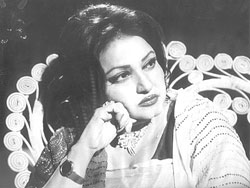
Showing posts with label NoorJehan. Show all posts

Monday, October 21, 2013

Darbari: The Royal Raaga


“A monumental raga, unmatched in Hindustani raga space for its gravitas, difficult in its swara-lagav, and profound for its emotional impact on the innocent and the illuminati alike.” 
– Rajan Parrikar

Kuch Ajab Khel Kartar ke- sings Shafqat Amanat Ali in this track from his album, Tabeer.  It is, according to him, his own interpretation of the age old Darbari bandish that has been passed on from generation to generation of the Patiala Gharana.


The original bandish is in fact said to have been one of the over 5000 bandishes that were passed on to the Patiala Gharana founders, Ali Baksh and Fateh Ali Khan by the great Ustad Tanras Khan of the Dilli Gharana- the very well known musician in the court of Bahadur Shah Zafar, the last Mughal King. He is the one who is said to have polished the Khayal singing of the two cousins to such an extent that they became the most formidable names in the whole of Northern India at that point in time
( Read in more detail about Ali Baksh, Fateh Ali Khan and how the Patiala Gharana came into being in this article


Another very famous bandish in Darbari which is attributed to Ustad Tanras Khan is based on the very famous tarana by Amir Khusro called “Yaar-e Mann beya” - Sung here by Ustads Salamat and Nazakat Ali of the Sham Chaurasi Gharana. 


A popular version by the Mekaal Hassan band of Pakistan


The most stately and distinguished of the Raagas, Darbari is said to have been created by none other than Mian Tansen, the legendary musician at King Akbar’s court. A Raaga performed at late hours of night, belonging to the Asavari thaat of the Bhatkande system of classification, Darbari is considered a difficult Raga to master. It is considered a gambhir Raga.  

The majesty and somber nature of this raga mandates its singing in the mandr saptak or lower octaves and in a slow tempo or the vilambit laya. The swaras Ga, Dha and Ni are komal or flat. In fact it is believed that the Dha and Ga swaras are not just komal but ati komal in Darbari. Another striking feature of the Raga is the use of andolan - the oscillation or swinging of the komal Ga and Dha which adds to its beauty and this is demonstrated in this short clip that demonstrates the aaroh and avroh of the Raga


Raaga Darbari- Aaroh, Avroh


But coming back to the Patiala Gharana and Kuch Ajab Khel , here is the bandish in its classical form being rendered by Ustad Amanat Ali and Ustad Fateh Ali Khan


Some More Darbari by the Patiala Gharana

First a short clip by Ustad Ashiq Ali- the son of Fateh Ali Khan one of the founders of the Patiala Gharana., who was “widely regarded as the ultimate statement of ‘tayyari’and ‘layakari’ by most of the vocalists of the Punjab region.” (read more about him here) http://www.sadarang.com/Ustad%20Ashiq%20Ali%20Khan%20-%20Saqib%20Razaq.htm


Next the very famous- Anokha Ladla, khelan ko maange chaand by Bade Ghulam Ali Khan, who also happened to be Ustad Ashiq Ali’s disciple


A beautiful ghazal by Ustad Amanat Ali Khan


And this  superb rendition by Ustad Fateh Ali Khan 


Ustad Fateh Ali Khan along with Zahida Parveen in this Darbari composition for a film


And the very popular duo of Asad Amanat Ali and Hamid Ali sing a tarana in Darbari


An interesting anecdote related to the raga is about Ustad Hafiz Ali Khan- the great Sarod maestro and father of Ustad Amjad Ali Khan. Apparently when he was at Rashtrapati Bhavan to receive his Padma award, the then president, Dr.  Rajendra Prasad asked if there was anything he could do for him.  The only request the latter had was that the President do something to save the Raga Darbari as he felt that people were taking too many liberties while performing it and since it was a precious creation of Tansen, he wanted it to be preserved in its purest forms for generations to come. The President was at a loss of words, recalls Amjad Ali Khan, who had accompanied his father for the function, but promised to look into the matter. A triumphant Hafiz Khan returned home to declare to his wife that the President would now be taking steps to save the great Raga!


NoorJehan, who is fondly remembered as Mallika- e – Tarannum; the Queen of Melody, also owes this title to Darbari it seems. Here in this video she recalls how it was singing the song Bulbulo mat ro yahan, based on Darbari for the film Zeenat in 1944 that earned her the title that stayed with her throughout her life and even after.


Talking of Darbari in Hindi films, there are scores of songs composed in the Raga

One top of the mind song is O duniya ke rakhwaale from Baiju Bawara. And here is the beautiful rendition of the sargam of the Raga by Ustad Amir Khan from the movie


And if there is one artist who has brought out the beauty of this Raaga in various moods in  Bollywood music ever so beautifully through his songs it is Manna Dey

He brings out the beauty of the shringar rasa in this Shankar- Jaikishen composition


Bhakti/ Vairagya in this very beautiful one created by SM Tripathi.. Ud ja bhanvar Manna Dey, which is supposed to be classic demonstration of the -'ati komal andolit gandhar'- a hallmark of Darbari


And surprisingly the raaga known for its serious demeanor used so beautifully for comic / humorous mood in these two songs


Pyaar ki aag mein  by SD burman


Lapak Jhapak from Boot Polish, composer: Shankar- Jaikishen


The Darbari has been beautifully used by AR Rahman for a couple of his projects:


Acid Darbari , 127 hours


Raaga’s dance : This one was composed by ARR for Vanessa Mae’s  album Choreography


Passion from The Last temptation of Christ , composed by Peter Gabriel, has Nusrat Fateh Ali Khan rendering some heartfelt Darbari


And lastly Shafqat’s most recent Bollywood song, Ras ke bhare tore main based on Darbari for the movie Satyagraha, though perhaps not  quite as impactful as the other Darbari that he sung.


Kuch Ajab Khel Ke Katar ke, Shafqat says, is a kind of a complaint or a shiqwa to the Almighty for His ways which are seemingly unfair…  and it is the Raag Darbari that makes sure that this plaintive, disconsolate plea reaches right up to Him in the heavens


Thursday, June 27, 2013

Rendezvous with The Ragas : The Allure of Aiman

"One must play with a Raga with a lover's passion. One must learn to love it to pay court to it, like a cavalier, and then alone can a musician tell the story of joy and grief; of laughter and tears.."- Ustad Faiyaz Khan

The magical world of Indian Classical music, where you experience everything with a sense of wonderment when you first enter it, for everything is ethereal, so beautiful… As you spend some more time with the bliss you begin to recognize some patterns, a systematic framework of sorts which gets adorned with the nuances of  the musical genius of a performing artist.

These templates  slowly make themselves visible to even people who are not trained formally in this field … the specific arrangement of musical notes that sets boundaries for performers and which also convert the art of music into a mathematical science that can be analyzed and studied in a systematic manner.

The word Raga is derived from Sanskrit and means color… Colors can be seen and described in words, colors can be given names but, colors are also experienced- they  evoke feelings and affect moods … Similarly the organization of music into Ragas has been done by applying the principles of Math and Physics but their emotional aspect adds a new dimension to the organizational structure of Indian Classical music- the dimension of rasas or moods, which has resulted in Ragas being categorized according to the time of the day and the season of the year and so on

I speak of the Ragas as a novice – an average music listener and lover who has just dipped a toe into waters of the vast ocean that Indian Classical music is... As I go along I hope to begin understanding a little more about these fascinating frameworks that  musicians use to weave their magnificent art..I write and speak from the heart as I begin my Rendezvous with The Ragas

Aiman/ Yaman

Miniature Paiting, Raga Yaman

"...that Raga of languorous waits, the Raga of the philospophers .It is endless, yes endless. If I look outside at the scene created by the setting Sun and the birds that move along slowly from nowhere to nowhere, I can only imagine that God felt too moved to create anything but Yaman.." - Vasudev Murty- 'What the Ragas Told Me'

“ When Aiman plays on the Sarangi, you can’t even move….if you love music even a little bit, that is” – Shafqat  Amanat Ali , on Coke Studio Pakistan

When Shafqat Amanat Ali romanced Aiman, the result was an “Ankhon ke Saagar”- the song that brought him in his own words “into the limelight” A great example of a Raga getting adapted for a popular, contemporary song.


This Raga, also referred to as Yaman, is supposed to be performed in the first quarter of the night, and is often associated with the feeling of peace , tranquility and an inner, spiritual joy. The mood definitely comes across beautifully in this song, which is amongst his most heard and performed songs


The origin and the technical nuances


There are various schools of thoughts about the origin of Aiman.  One of the most popular ones credits Amir Khusro with its creation. It says that Amir Khusro created this Raga along with others like Zilaaf and Sazgari- the latter two are now extinct and no longer performed. However, Khusro himself in his 'Ejaz –e Khusravi 'mentions that he didn’t create the Raga, and it already existed in the Iranian and Indian music. This sounds plausible  because Yaman or Aiman is also considered by many as an innovative blend of the Raga Hindol of Hindustani with the Persian Nairez or Nairiz. 

There are others, however, who believe that the Raga always existed in the Indian classical music as Yamuni, which later became Yaman.

The classification of Hindustani Music that we follow today is the result of extensive work and research of a man called Pandit Vishnu Narayan Bhatkande- he gave us a system that consists of Thaats- families, under which different Ragas are classified. The Thaat represents the parent scale of which the Ragas in that family are a subset.

Yaman or Aiman is a complete or Sampoorna Raga as it utilizes all the seven swars. It falls under the Kalyan Thaat- and is characterized by the use of a teevr (sharp) madhyam. Another very similar raga from the family is the Yaman Kalyan which uses both the teevr and shudh madhyam

This video explains the difference of the teevr and shudh Ma very nicely!


Here’s Ustad Fateh Ali Khan rendering a delightful bandish in Aiman composed  by his grandfather and one of the founders of the Patiala Gharana- Ustad Ali Baksh , also fondly called Jernail . Accompanying him, his nephew- Shafqat’s eldest brother, Amjad Amanat Ali


Aiman in Light Music

Fuzon’s and Shafqat’s engagement with Aiman didn’t end with Aankhon ke Saagar. They did a Neend Na Aaye which too was based on this Raga. But this was before the band broke up and the song was released by Fuzon in their album in the voice of another vocalist. Shafqat’s unreleased version is however available on YouTube


Light music , including ghazals , geet etc.  are often based on or inspired by the Ragas. But unlike the strict mathematical precision of the classical format , this genre often takes liberties in composition and even mixing of Ragas in one song are quite common

And, since the Yaman Kalyan is so similar to and hard to differentiate from Yaman for a listener like me, and also because one modern school of music thinks that the distinction between them  is too little and that they should be considered the same Raga; and mostly because they are so close to my heart, I will be mentioning songs here which may be both  Yaman and Yaman Kalyan based...

So many of my favorite ghazals are in Raga Yaman- Most popular of course is Aaj jaane ki Zid na karo, sung by many including Shafqat.


An absolute, absolute favorite by Noorjehan…'Mujhse pehli si mohabaat mere mehboob na maang' also brings out the beauty of this Raga so well. Faiz is said to have permanently dedicated this ghazal to her after he heard her rendition…


And not too long ago I discovered this one - Yaar ko maine , mujhe yaar ne- beautiful words by Khwaja Haider Ali Aatish composed as well as sung by Ustad Amanat Ali


And this is a clip of Shafqat singing it an interview


Yaman seems to be the mother of all Ragas when it comes to Raga based compositions in Hindi films-There are so many film songs based on this beautiful raga that you can keep counting.


Music director Roshan’s Yaman based  ‘Mann re tu kahe na dheer dhare” by Rafi remains one of my most favorite songs, ever. “Abhi na Jao chor kar” is another one by Rafi where he teams up with Asha – a brilliant romantic number with music by Jaidev. Another Yaman beauty by him is- “Ehsan tera hoga mujh par’ composed by Shankar Jaikishen.

Shafqat recreates the magic of Rafi’s Din Dhal jaaye on the Sony Mix Solos in this video…This time it was S.D. Burman who had brought  Yaman and Rafi together


My father is a die-hard Saigal fan and would play him all the time when I was a kid despite my siblings and I protesting. It was only many years later that I actually begun to enjoy the  singing of this great music legend. His very famous Do naina matware tihare and Diya jala are Yaman based, I believe.

And here Shafqat renders  K.L. Saigal’s Main kya jaanu kya jaadu hai… when asked to sing a song that he heard in his childhood that had had an impact on him, thus affirming his special connection with Aiman…


The list is of film songs based on Yaman simply endless and goes on...


The Devotional Side

The  mood of  Yaman has been beautifully utilized  for devotional or Bhakti compositions as well. Lata’s Sri Ramchandra Kripalu bhaj is a popular one.

I, especially want mention three songs in this genre here ( All, I believe, in Yaman Kalyan)

If you visited my home many years ago chances of these you hearing  these  first two songs in the background would be very high. They were a big favorite with my father and gradually we, the rest of the family, also began to enjoy these.

In the first, Pandit Jasraj sings an ode to the young child Krishna-


Rani tero, Pt Jasraj


The second one  by Kishori Amonkar, is also a prayer dedicated to Lord Krishna, who is called Banke Bihari…


Mharo Pranam, Kishori Amonkar


The third is the result of my engagement with  Sufi music, which began with a love for Sufi poetry and this one has the sublime words of Amir Khusro and the inimitable voice and style of Nusrat Fateh Ali Khan


Munn Kunto Maula, Nusrat FatehAli Khan


So that’s the Raga for you- ancient, versatile, soothing, stirring…it certainly is hard to resist the Allure of Aiman

Some trivia

- Often  the first Raga to be taught to students as it is complete and contains all notes, thus making it ideal for training the voice

- The soothing feeling attributed to the raga is due to use of  Tivra madhyam  interspersed with 6 shudh swaras

-  It is a documented fact that listening to Aiman lowers stress and blood pressure, and also benefits patients of rheumatoid arthritis 


Wednesday, November 28, 2012

Jingle Bells, Soap Bubbles and other such (IV)


For the love of my country…
This is another in the series that talks about Shafqat Amanat  Ali’s patriotic songs

Our hearts where they rocked our cradle, Our love where we spent our toil,
And our faith, and our hope, and our honor, We pledge to our native soil.
God gave all men all earth to love, But since our hearts are small,
Ordained for each one spot should prove, Beloved over all.

~Rudyard Kipling

It is that time of the year, where the entire UAE, my current country of residence, gets into a celebratory mood. The national day is around the corner and the festivities are on. The red, green, white and black colors are everywhere- as merchandise in shops, as flags, big and small- adorning houses and official buildings, as the bright lights twinkling and lighting up all prominent landmarks across the country… and all this warms my heart and fills it with pride for the country that I have called home for the last 7 years.


I have always been quite emotional when it comes to patriotism. I still set an alarm to wake up on the morning of 15th August to see the Prime Minister unfurl the tricolor at the Red fort. I still love to sit through the entire telecast of the Republic Day parade on the morning of 26th January, if I get a chance. Give me a sports team singing their national anthem along with their supporters in a packed stadium, or an athlete who just won a medal for his country looking with tremendous pride at the flag of the country being hoisted…or even the soppiest patriotic Bollywood movie scene (remember the Jan Gan Man singing one from KJo’s K3G?) and you will find me with a lump in my throat and a tear in my eye..

In an interview,interestingly to a Pakistani TV channel, Lata Mangeshkar while remembering Noor Jehan mentions the beautiful patriotic songs that the latter has sung. When asked further on how an artist feels when they sing a song for their country, she says that it is a matter both of duty and pride…

Pride and passion both certainly reflect in his voice as Shafqat Amanat Ali sings these tributes for armed forces of his country…

Pasbaan


Jazba


Ever wondered how Rahat Fateh Ali Khan and Shafqat would sound if they sang together? You can find out right here on this video where they get together to sing about the challenges of fighting terror in their country


And here is another where he teams up with Najam Shiraz


A peppy, motivational one with Fariha Parvez 


But saving the best for the last- one of the best patriotic songs, ever, in my opinion- And it gives me goose bumps to listen to its live, and heartfelt rendition by Shafqat, here


Another live rendition


The song was rendered originally by Shafqat’s father, the great Ustad Amanat Ali and this is the video, a tribute to the late Ustad,  that features the original song in his voice. It is also features Shafqat and his son and represents beautifully the handing down of music, culture, and values like patriotism from one generation to another.


“I like to see a man proud of the place in which he lives. I like to see a man live so that his place will be proud of him,” said Abraham Lincoln. His songs definitely reflect his love for his country and I am sure his country feels proud to have a son like Shafqat Amanat Ali.

Monday, November 12, 2012

Jingle Bells, Soap Bubbles & Other Such... (III)


Keeping the Music Alive..

This one talks about the songs Shafqat has sung as a tribute to various artists- musicians and composers

"The only thing better than singing is more singing" ~ Ella Fitzgerald

Noor Jehan


In a radio interview an RJ asked Shafqat Amanat Ali, "Who is the one female singer in Pakistan that you would choose to sing a duet with?" "Madam Noor Jehan," was his instant reply. The legendary singer, who enthralled generations in the sub-continent with her sweet and melodious voice, the one who was aptly conferred the title of "Mallika - e- Tarannum" is the pride not just of Pakistan but of music lovers across the subcontinent.

Here is Shafqat paying her a tribute by singing one of her songs. This was when he was a part of the Fuzon band


And this is the original by the legend herself 


The closest thing that can help one to imagine how Shafqat would have sounded if he sang with Noor Jehan  would be  this duet of hers for a Pakistani film which she sang with  Shafqat’s father, the great Ustad Amanat Ali.


****

Ustad Amanat Ali Khan/ Asad Amanat Ali


Shafqat maintains that one of the greatest inspirations for his music is his own father who enjoyed a great amount of popularity and respect among the music lovers in the 60’s. Not only was he an accomplished classical vocalist, he is also ranked among the finest Ghazal singers of all times.

Shafqat recalled a very interesting anecdote related to his father in a TV interview recently. In the 60’s there was a particularly bad year in Pakistan where the monsoons had been much delayed causing a lot of woe, especially to the farmers. The great Ustad, a firm believer in the power of music, suggested to one of his radio producers that they should compose a prayer to God requesting him to end the plight. Legend has it, that as the song was being aired on the radio, the first drops of the monsoon actually began to fall…

Here’s Shafqat singing the same song


He sings one of his father’s ghazal  here and also pays tribute to his brother Asad Amanat Ali, another star of the family.


Hothon pe kabhi unke mera naam bhi aaye- is one of the most popular ghazals rendered by Ustad Amanat Ali and one of my favorites. And Kisi aur gham mein itni khalish e niha nahi hai would probably make it to the top 3 of my all-time favorite ghazals

Here are the original renditions by the maestros


Both the brothers have paid a tribute of their father by singing one of his songs together.


The original

You can see that both the brothers have inherited their father’s singing traits. While Asad has more of the khanak, the joyful tinkle in the voice and the ability to play with the notes, Shafqat has inherited the calmness, the sukoon, the ease, as well as the ability to explore and pursue the notes to their ultimate height or depth!

Read about and hear Shafqat’s rendition of Asad Amanat Ali’s famous Punjabi song Umra Langiaan- in this blog post 


****

Mehdi Hassan


"He had a very mellow and melodious voice with an immense command on diction at the same time. You don’t need anything else to make an outstanding singer,"- Shafqat Amanat Ali about the Mehdi Hassan after the passing away of the Ghazal King

Here's Shafqat singing his "Zindagi mein to sabhi pyaar kiya kartein hain"


And Mehdi Hassan’s live rendition 


And here he sings a Mehdi Hassan song composed by the great composer Sohail Rana


The original


*****

Sohail Rana is also the composer of the very popular Aaj Jaane Ki zid na karo- read more about Shafqat’s rendition of the song as a tribute to the composer here

Jagjit Singh


One of the most popular Ghazal singers, ever, whom we lost not so long ago… and when the industry joined hands to pay him a tribute , Shafqat Amanat Ali was there, too, with this ghazal of his


The original

****
Bollywood retro

And when I hear Shafqat sing..

Lata Mangeshkar ‘s Allah tero naam


Hemant Kumar’s Ye Nayan dare dare


Rafi’s Ajhun na aaye balma & Din dhal jaaye


Kishore’s tere bina zindagi se koi ( towards the end of  this video) 

http://ibnlive.in.com/videos/244220/wish-i-had-sung-tere-bina-zindagi-se-koi-shafqat.html

And above all  Saigal's (unfortunately only on a TV promo, and thus very briefly)  main kya jaanu kya jadoo hai
(for  a show on Geo TV- if someone has a video of it please do share)

I start thinking that Shafqat should formally sing some of the golden classics from Bollywood for an album. I even have a wish list…
  • Kasme wade pyar wafa  by Manna Dey
  • Koi sagar dil ko and Man re tu kahe na dheer dhare by Rafi
  • Wo sham kuch ajeeb thi by Kishore
  • Sajnwa bairi ho gaye and Kahin door jab din dhal jaaye by Mukesh…and the list could go on and on…

As they say... if wishes were horses... :)